
Screven Prison Release Destinations
A person leaving Screven County Prison may enter the community after discharge, begin parole, continue probation under a court sentence, or transfer elsewhere in GDC custody. Parole is supervised release after part of a prison sentence. Discharge means the state custody obligation reflected in that record ended. Neither term should be inferred from a missing county jail listing.
Screven County Prison is a county correctional institution listed by GDC, not the short-term Screven County Jail. Its population is tied to state-sentenced custody. The state's offender query, parole board, and Department of Community Supervision therefore form the correct release path.
| Jail outcome | Next record | What it confirms |
|---|---|---|
| Bond or court release | Sheriff record and court docket | Local custody ended; case may continue |
| Time served | Release record and sentence | Local custody term ended |
| Transfer to GDC | GDC offender query | State custody followed jail custody |
| Federal or ICE transfer | BOP, PACER, or ICE locator | Another system may still hold the person |
Confirm Screven Prison Discharge
Begin with the GDC offender query. Search by GDC ID when known, or use name and available descriptors. Compare the current status, most recent institution, offense and sentence information, and release-related dates. A current state-prison record and a released or discharged record answer different questions.
- Give the sheriff the full name, approximate booking date, and date of birth if known.
- Ask for booking date, release date and time, release reason, bond, charge, case number, and receiving agency.
- Check the court disposition through re:SearchGA or the correct clerk.
- Use Georgia VINELink when custody may be current or an alert was registered.
- If the record says state transfer, use the GDC offender query.
Screven Prison GDC Records
The GDC facility page identifies Screven County Prison in the state system. Use GDC for offender status and state sentence records. Use the sentencing court for the judgment, and the State Board of Pardons and Paroles for parole process or public decision material.
A useful request identifies one booking event and asks for the releasable booking and release record. Include the person's full name, date of birth if known, and a short date range. Request the booking and release times, reason or type of release, charge, bond, court or case number, receiving agency, and booking photograph if releasable. Narrow requests reduce confusion and avoid unrelated records.
Georgia's O.C.G.A. § 50-18-71 governs response timing and allowable costs. An agency generally responds within three business days by producing records, denying access, or stating when records will be available and why more time is needed. Search, retrieval, redaction, and copying charges can apply. Ask for an estimate if cost matters.
Screven Prison Custody Scope
Screven County Prison belongs to a different release world from the jail. State sentence computation, GDC status, parole eligibility, disciplinary action, sentence credit, and court orders can affect dates. A maximum possible release date is not a promise of the exact day or time a person will leave.
The GDC locations directory provides the successful page-matched image below.
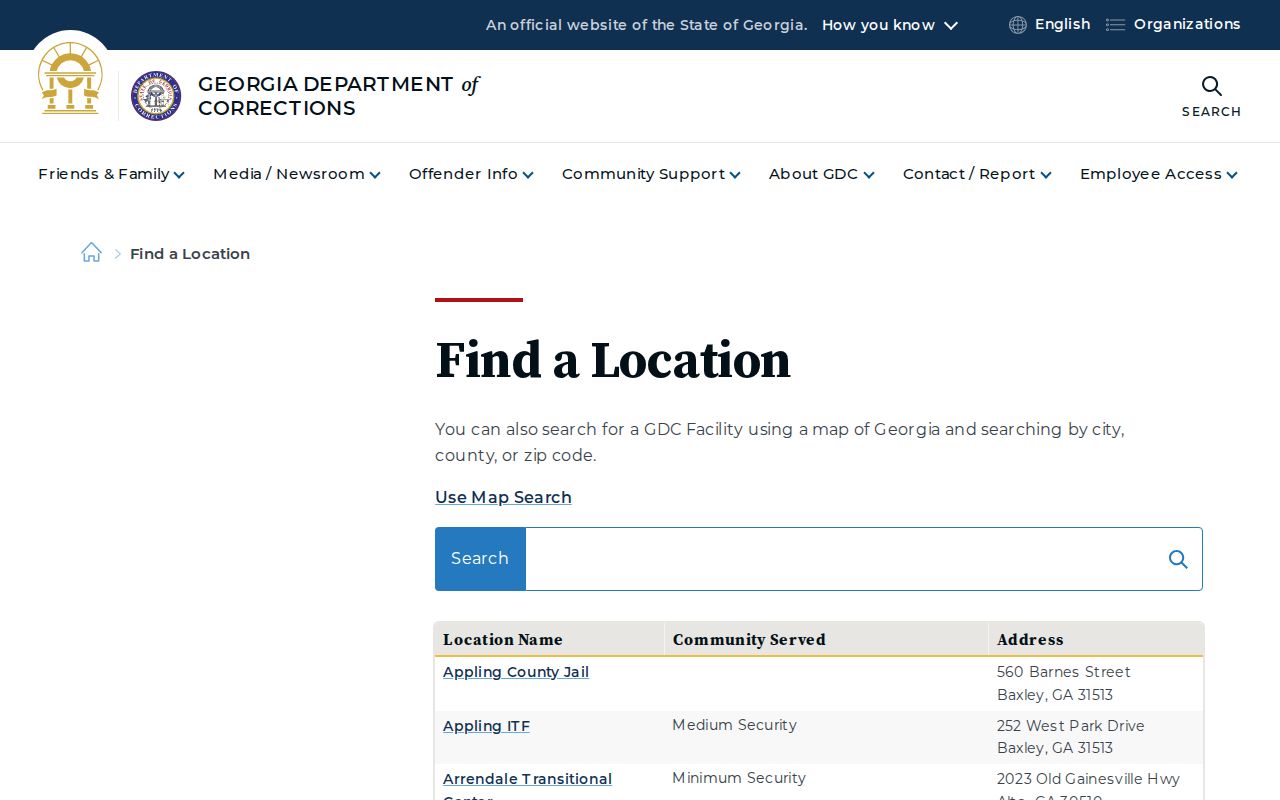
The directory confirms the state-corrections context. The offender query, not the directory alone, supplies person-level release information.
Screven Prison Parole Status
Parole eligibility is not release. The board can grant, deny, defer, or rescind action, and processing may remain after a grant. Review parole consideration material and public decisions only after matching the person in GDC.
When release includes field supervision, use the DCS office locator. Office assignments can change. The locator is safer than relying on a hard-coded local office.
Screven Prison Sentence Follow-Up
GDC date fields can change with credits, discipline, parole, statutory limits, and court modification. Georgia law at O.C.G.A. § 17-10-6.1 imposes restrictions for listed serious violent felonies. Do not apply one release percentage to every sentence.
Compare the GDC record with the sentencing judgment when a date seems unclear. Jail credit, later court orders, and the offense-specific rules can affect sentence computation. A parole decision adds another layer: eligibility means the board may consider release, while a grant reflects favorable board action subject to conditions and processing. A denial or deferral means custody continues unless another lawful basis changes it. These distinctions are especially important at Screven County Prison because the state-sentenced record, not a local recent-release list, carries the durable status.
After a supervised release, the Department of Community Supervision becomes the field-contact route. Supervision is not the same as incarceration. It can continue after the person leaves the institution, and its end may require a discharge or court record. Use GDC to establish the prison release, parole materials to understand board action, DCS to locate the current supervision office, and the court record to confirm the sentence that produced those events.
If a record is absent, it may be held offline, sealed, restricted, juvenile, or maintained by another court. Do not infer the outcome from absence alone. The full Screven County released inmate search explains how sheriff, court, GDC, and supervision records fit together.
Screven Prison Search Fields
The GDC ID is the strongest search key because names can repeat or change. When it is unavailable, use the person's full name and compare descriptors, offense information, status, and most recent institution. Do not select a result by name alone. A state offender record may show current status, sentence and offense entries, institutional history, release-related dates, and an offender photograph when public. Each field adds identity or custody context.
Read status before reading a projected date. A person can remain in custody even when the record contains a future maximum possible release date. A released or discharged status can remain visible after the person leaves. If parole appears, confirm the board action and whether community supervision follows. If the record shows transfer between state facilities, that is not a release from GDC custody.
A GDC offender photograph is a state correctional image, not the booking photo from Screven County Jail. Likewise, the GDC sentence record does not replace the sentencing court's judgment. Use each record for its own purpose: GDC for state custody and release status, the parole board for board decisions, DCS for supervision-office routing, and the court for sentence and later modification orders. This source-by-source approach preserves the distinctive state-prison path documented for Screven County Prison.
When dates change, save the current GDC result and check the source again. Sentence computation is maintained by the state system, so family estimates or an old screenshot cannot override the latest official status and court record.